Monday, May 28, 2018

Charlotte Mason in a Nutshell

For our school we will be following a curriculum based on the works of Charlotte Mason. Charlotte Mason was a school teacher in the 1800's who devoted her life to the nurturing of children. There are several things that define a Charlotte Mason education, and I probably can't cover them all in a single blog post--particularly not in depth, and this won't be in order of importance either.

Quoting from the Ambleside Online Website: "First and foremost, Charlotte Mason is a 12-year Christian Character Building curriculum. Books are chosen not for cultural literacy so much as the literary quality with which they were written, and even more, their ability to develop the whole person and inspire his character. For all those years that children are getting a CM education, what's really being trained more than anything else is their character. Students receiving a CM education don't need any character building program because the entire curriculum is geared towards building character with the use of personal habits, quality books, teacher guidance, the work of the Holy Spirit and personal reflection."

A Charlotte Mason Education involves living books. A living book is a story well-told, one written as a first hand account, or by someone who knows their subject well and loves it well and writes it well. It is not a dry textbook. It should spark interest and delight in the child, and impact his or her mind with its ideas.
The world is a great treasure house full of things to be seen,
and each new thing one sees in a new delight. ~Charlotte Mason

A Charlotte Mason Education involves narration. Narration is when a child "tells back" what was just read to him. There is only one reading allowed, and he may not look back over the text in order to do his narration. Once read, once told. In the early years (grads 1-3 or so) narration is oral, and is required after every reading. Gradually as the child gets older, written narrations are added. Narration takes the place of formal writing lessons and even tests. Grammar is not required, particularly early on. Outside of the end-of-term exams--which are also oral in the early years--there are no tests. Even the exams are not graded, instead they are for the teacher's assessment, in case there are adjustments to be made for that particular student.

A Charlotte Mason Education involves time outside--especially in the early years.
It is infinitely well worth the mother’s while to take some pains every day to secure, in the first place, that her children spend hours daily amongst rural and natural objects; and, in the second place, to infuse into them, or rather, to cherish in them, the love of investigation. ~Charlotte Mason (Home Education, p 71)
And another one I love:
The study of natural history and botany with bird lists and plant lists continues throughout school life, while other branches of science are taken term by term.” -Vol 6 Charlotte Mason 
What to do outside? A nature journal focused on different things per term--stars, trees, flowers, animals, bugs, etc. Drawing helps them to see what is really there, rather than what they expect to see. Learning names, learning uses, learning what plants look like one season to the next. Learning the sky. There is so much that can be learned, and this area of study is typically absent in education now--at very least, it is given a low priority--despite the growing body of evidence that it is an absolute necessity for a well formed mind.

A Charlotte Mason Education involves Habit training. To ignore a child's habits--or to separate that out from the schooling process--is to miss the mark of education.

 This relation of habit to human life––as the rails on which it runs to a locomotive––is perhaps the most suggestive and helpful to the educator; for just as it is on the whole easier for the locomotive to pursue its way on the rails than to take a disastrous run off them, so it is easier for the child to follow lines of habit carefully laid down than to run off these lines at his peril. It follows that this business of laying down lines towards the unexplored country of the child's future is a very serious and responsible one for the parent. It rests with him to consider well the tracks over which the child should travel with profit and pleasure; and, along these tracks, to lay down lines so invitingly smooth and easy that the little traveller is going upon them at full speed without stopping to consider whether or no he chooses to go that way. ~ Home Education, P 109

There are many habits a child needs in order to travel along smoothly through life, and the appropriate place to address those needs is both at home and in the school room (which, in my case, are the same).

This is a nutshell version of what a Charlotte Mason education looks like for a student. There are so many other aspects of the Charlotte Mason Philosophy that really couldn't be covered in a single post. Some other topics that I would like to cover are: Charlotte Mason's 20 Principles of Education, What a Charlotte Mason education looks like for a teacher, and ways that her principles impact daily life outside of "school hours." I suspect that list is going to grow the more I write--there is so much depth to this lifestyle!!

For those of you who are also using Charlotte Mason's philosophy for teaching your children, what would you add to my list? 


Friday, May 25, 2018

A Continual Feast


I was introduced to this book through Cindy Rollen's Advent book, Hallelujah: a Journey through Handel's Messiah. It has well earned it's place on my shelf over the last 6 months of heavy use. Something I have been studying is how to work the traditional church calendar into our daily lives. There are many reasons we have begun to embrace this, but one of the greatest is that the cadence of the calendar draws our attention from one aspect of God to another in a beautiful, steady rhythm. We can make one thing our focus for a season, knowing that soon enough that season will be passed and we will be moving on to the next.

In the Old Testament God gave his people different feasts and fasts to keep through the year. In much the same way, the church calendar is a litany of feasting and fasting. Lent, Advent, 12 Days, Easter, Pentecost--each of these bring with them a season of joy or sorrow, of feasting or fasting. Each of them cause us to question--why? Why are we celebrating the day? What has God commanded us to remember? What is important about this dish, this day, this season? Each of them focus in on a different part of God's work. And, what more useful as we observe these traditions than a beautiful cookbook focused on the traditional recipes and observation rituals of each season?

 Divided into sections based on each feast, ordered according to the calendar for ease of use, A Continual Feast has been the perfect addition to my cooking library. Most recipes contain commentary about how that recipe was used traditionally, and what it symbolizes in the feast (which I find personally interesting, and is also helpful as the children ask questions!). The recipes range from very, very old--I loved the reprint of a recipe from the 1600s involving pheasant feathers "cunningly set about" a roast bird--to more modern ideas like the Pentecost Cake that is piped with symbols of the holy spirit. Most of them comfortably tiptoe between ancient and modern.

Some of the feast recipes can be fairly complicated, but they are doable and not intended for daily use. I found many of the more labor intensive Christmas recipes were actually made well in advance, because traditionally that was how it was done. Other recipes are fairly simple and meant to either round out the feast or be a daily go-to in seasons where creativity is the key (Lent can be a challenge!!).

All in all, this book has been a delight and has added a great deal to our year. I haven't pictured my personal copy because, well, a few encounters with the counter have made it not particularly pretty. But only because it has been so well loved.


Monday, May 21, 2018

Norms and Nobility--prologue


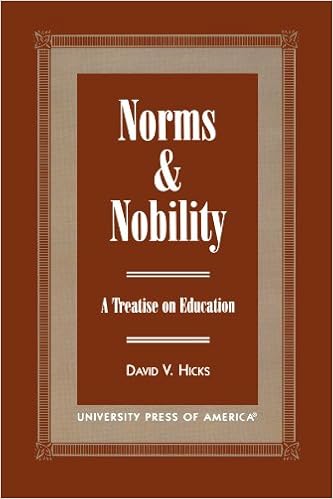
As part of my continuing teachers education I'm taking a course next year through Circe Institute's Atrium program. We will be working through the book, Norms and Nobility by David Hicks. This book on offers a compelling argument in favor of classical education and how true education involves so much more than the small areas we have relegated it to in modern thought. Education involves the whole person, not just a body of facts that must be learned over the course of 12 or so years.

I'm going to try blogging my way through the book, chapter by chapter (or, likely, section by section. It may not be entire chapters at once) over the course of the next year. I'm starting my read through a bit early as I find that I have a bit more time on my hands for reading now than I had expected. (More on that in a future post, possibly.) So, without further ado, here is my summary-with-thoughts of the Preface

 Norms and Nobility--Preface


Written ten years after the publishing of the book in 1981, David Hicks seems to have mellowed a bit. I found it interesting that he said, if he were to write this book again, he would make fewer sweeping claims for the ancients. They did not have all the answers, and the answers they had were not unified. They did not all come to the same conclusions. Rather, Norms and Nobility is "about an ancient ideal expressed as "classical Education" against which the modern school is weighed and found wanting."

The ultimate aim of education, he goes on to say, is not thinking but acting. It isn't knowing what to do, but doing it. "The sublime premise of a classical education asserts that right thinking will lead to right, if not righteous, acting." Children do not just need to be trained into rational, logical thinkers. Facts are not enough. They need to be able to act in a wise and noble way.

From my commonplace:

Those who believe as I do that teaching students to reason well is not enough threaten, Alder would argue, to turn education into indoctrination while placing a greater burden on the teacher and his lesson than either can bear. Yet it seems to me that the difference between indoctrination and education is more one of degree than of kind, and my teaching experience has lead me to believe that unless my aims are more broadly defined than to make my students rational thinkiers, I will surely fail to achieve even that. Education must address the whole student, his emotional and spiritual sides as well as his tational. The aims of education, the teachers methods, the books and lessons, the traditions, and regulations of the school--all must express not just ideas, but norms, tending to make young people not only rational, but noble.
 This is why the high value that modern methods of teaching place on skepticism is, perhaps, misplaced. In modern thought, dogma is bad but skepticism is good. Students are encouraged to accept nothing, question everything. These adolescent students are, as yet, untrained and inexperienced and yet they are expected to have the capability of being able to distinguish for themselves right and wrong. Skepticism rejects the idea that anything deserves our wholehearted allegiance--everything must be questioned.

The emphasis placed on skepticism and analysis has likely come from those who watched these tools used in the field of science, and saw the wonders that were discovered as a result. The tools were taken and applied to the areas of traditional wisdom and morality to grave consequences. Surely it is possible to both accept that there are certain areas that are simply right or wrong, and other areas where the use of skepticism and analysis is a useful tool.

Perhaps, though, it is not the schools curriculim, but rather the teachers themselves that are most in need of reform. A teacher must first be a student, and as soon as a teacher stops learning he or she can no longer truly teach. The greatest value in the curriculem he proposed, David Hicks continues, "is that it sustains and nurtures teachers as practitioners of the art of learning while discouraging nonlearners from entering the profession."

Only a school (and by extension a curriculum) that encourages teachers to be always learning will keep its teachers fresh and fearless and its students happy and motivated in their studies, ready to test their lessons against life. 

I have to admit, as I enter my fourth week of first grade homeschooling my oldest, I am so excited to read this book. As I see her eyes light up as she comes into contact with the Great Books and makes her own connections makes me fully believe that this is true. There is so much more to education than passing a series of tests.